Most of what we make doesn't exist yet. A bracket that snapped and isn't sold separately. A housing for a board you designed. A badge for a client's shopfront. If you can describe it or hold it, it can usually be printed.
Four situations that come up again and again. Yours may not be on the list — send it anyway.
A knob, clip, bracket or cover that failed on something otherwise fine. Manufacturer wants you to replace the whole unit, or stopped stocking the part a decade ago.
Keychains, tags, counter displays and giveaways carrying your logo. Two-colour printing means the branding is part of the plastic, not a sticker that peels.
Before you commit to a mould or a machinist, hold the thing. Cheap iterations, days not weeks, and dimensions you can verify with callipers.
When the geometry is organic or too complex to measure, we photograph it from every angle and rebuild it as a mesh, then clean that into a printable model.
A replacement part from start to finish: broken original in, working part out.
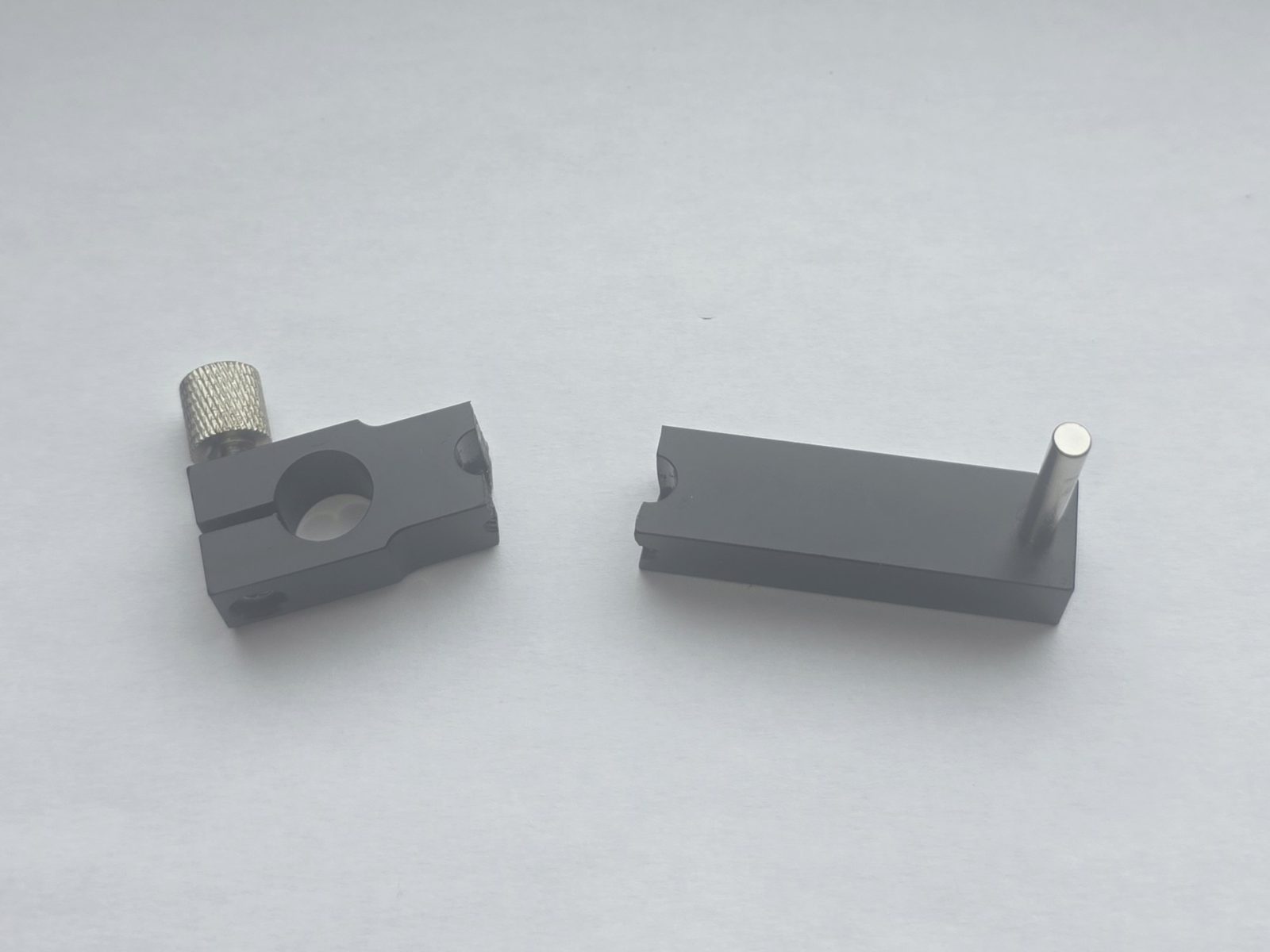
The plastic blade holder arm on a vinyl cutter broke clean through, and the rest of the machine was fine. Rather than replace the whole assembly, we remade the arm.
No fixed price list, because no two jobs are the same size. Here's what actually drives the number, so a quote isn't a surprise.
| Material | Grams of filament on the plate. Big solid parts cost more than big hollow ones — infill is a lever we can pull together. |
| Printer time | Hours on the bed. A tall detailed part can run overnight; a keychain takes twenty minutes. |
| Design time | Zero if you send a ready STL. Otherwise, the hours to model it. This is usually the biggest line on a first-off job — and it's a once-off, since reprints reuse the model. |
| Quantity | Ten of something costs well under ten times one, because the design work is already done and the plate runs full. |
| Finish | Straight off the printer is free. Sanding, priming or painting is extra time. |
Send the details and you'll get a firm number before anything starts. No deposit taken until you've agreed the quote.
Two workhorses cover nearly everything. We'll tell you which one your part wants — and say so if 3D printing is the wrong answer entirely.
Stiff, dimensionally accurate, takes fine detail and paint beautifully. The right pick for display pieces, figures, prototypes and anything living indoors.
Avoid for: anything left in a car, in direct sun, or under sustained load. It softens with heat and creeps.
Tougher, more temperature tolerant, slightly flexible instead of brittle. The default for outdoor gear, automotive parts, and anything that gets handled hard.
Avoid for: fine crisp detail and smooth paint finishes — it's glossier and stringier than PLA.
Load-bearing suspension components, anything structural under vibration and heat, parts where failure means someone gets hurt. Printed plastic creeps and fatigues in ways machined metal doesn't. We'd rather point you at a machinist than sell you a part that lets go.
Upload an STL, OBJ or STEP file if you have one — or send photos, measurements and a description.
You get a price, a material recommendation and a realistic timeline before anything is printed.
Collect in Bela-Bela or have it couriered anywhere in South Africa.